
The 1920 Wheat Penny belongs to the Lincoln cent series produced in the United States between 1909 and 1958.
This specific issue is characterized by a significant production volume distributed among three state facilities.
Assessing the market 1920 Wheat penny value requires conducting a detailed analysis of physical preservation and surface luster classification.
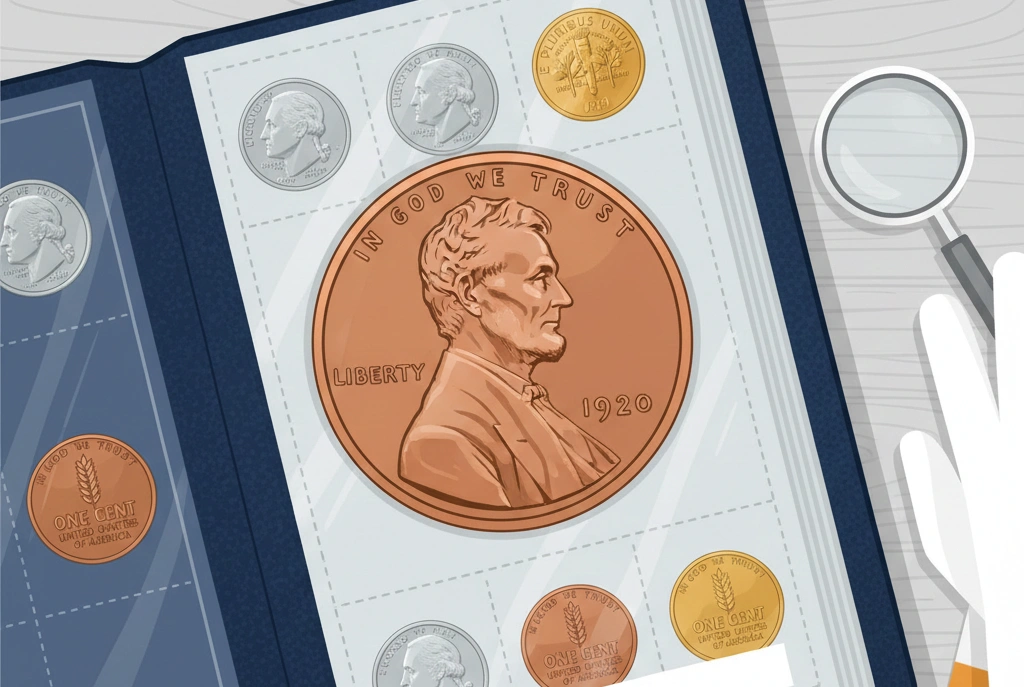
Studying confirmed data reveals a direct dependence of the price on the Sheldon scale grade.
1920 coins were struck in Philadelphia, Denver, and San Francisco in accordance with a single state standard.
Planchet parameters were strictly regulated by United States legislation.
Characteristic | Parameter |
Alloy Composition | 95% copper, 5% tin and zinc |
Weight | 3.11 grams |
Diameter | 19.00 mm |
Edge Type | Plain |
Designer | Victor David Brenner |
In 1920, the total mintage amounted to 462,832,000 specimens.
Mint Facility | Mint Mark | Mintage Quantity (pcs) |
Philadelphia | None | 310,165,000 |
Denver | D | 49,280,000 |
San Francisco | S | 46,210,000 |
The difference in mintages directly influences the rarity of coins in the highest preservation states.
Color Classification and Its Price Impact
Professional expert organizations, including PCGS and a coin appraisal app, divide copper coins into three categories depending on surface oxidation.
This classification acts as the determining factor during the formation of market quotes.
Brown (BN). The surface being entirely brown and lacking original luster.
Such specimens constitute more than 95% of the surviving mintage.Red-Brown (RB). A surface having retained between 5% and 95% of the original orange-red color.
The value of such coins in MS65 grade exceeds the BN category price by 2–3 times.Red (RD). A coin having preserved more than 95% of the original mint luster.
This category represents the greatest investment significance.
Statistics show a price drop of 70–85% when a coin transitions from the RD to the RB category resulting from improper storage.
Philadelphia Issue (1920 No Mint Mark)
Coins lacking a mint mark are the most common among 1920 issues.
Most surviving specimens possess significant wear, being valued within the 20–50 cent range.
Investment potential manifests upon reaching the MS66 RD grade.
MS65 RD: The price varies from 50 to 85 USD.
MS66 RD: The value stands at 150–220 USD.
MS67 RD: A rare grade valued at 1,500–2,100 USD.
An auction record for a 1920 coin without a mint mark was recorded in 2006.
A specimen in MS67+ RD grade was realized for 12,650 USD.
This price resulted from the absence of surface defects and exceptional strike clarity.
Denver Issue (1920-D)
The Denver issue in 1920 was produced using worn dies, leading to low detail definition on many specimens.
Coins featuring a sharp strike in MS65 condition and higher occur extremely rarely.
Grade (RD) | Average Price (USD) | Population Stats (PCGS) |
MS64 | $150 | 480 |
MS65 | $650 | 112 |
MS66 | $2,800 | 15 |
MS67 | $40,000+ | 1 |
The absolute price record for a 1920-D was set in 2012.
A coin in MS66 RD grade was sold at auction for 21,150 USD.
Later, in 2019, the price for similar grades showed a temporary 12% decrease due to several new certified lots entering the market.
San Francisco Issue (1920-S)
The San Francisco issue is considered the most difficult to find in ideal condition among 1920 coins.
The main part of the mintage was released with a weak strike, depriving the image of Lincoln's beard and wheat ears of fine details.
MS64 RD: Valued at 400–600 USD.
MS65 RD: The value reaches 2,500–3,500 USD.
An auction record for the 1920-S is fixed at 48,875 USD for the MS65 RD grade.
The high price is explained by the presence of only 14 specimens in this grade according to PCGS reports.
The annual value increase for 1920-S in RD condition averages 4.5–6% over the last ten years.
Market Value by Grade (USD)
Data are based on average auction sales indicators for 2024–2025 for the Red (RD) category.
Grade | 1920 (P) | 1920-D | 1920-S |
MS63 | $25 | $95 | $120 |
MS64 | $45 | $185 | $450 |
MS65 | $90 | $750 | $3,200 |
MS66 | $250 | $4,500 | $18,000 |
In grades below MS60, the price for all mints levels out, standing between 1 and 5 USD for specimens in good condition (XF–AU).
Confirmed Minting Errors and Varieties
Production defects of 1920 significantly increase the coin's value regardless of standard price tables.
Identifying such samples requires using optical equipment with 10x magnification.
Doubled Die Obverse (DDO). Doubling of the date and "LIBERTY" inscription detected.
The price varies from 50 to 300 USD depending on the effect's prominence.Off-Center Strike. Off-center minting with image displacement.
A 10% displacement increases the price to 100 USD; a 50% displacement preserving the date can cost over 500 USD.Die Cracks (BIE). Die cracks creating a vertical line between the letters B and E in the word LIBERTY.
The price of such coins stands at 5–15 USD.Lamination Errors. Metal flaking on the coin surface.
The defect is valued at 10–40 USD depending on the damage area.
The presence of a production error makes the coin a unique object, excluding it from the general statistics of mass mintages.
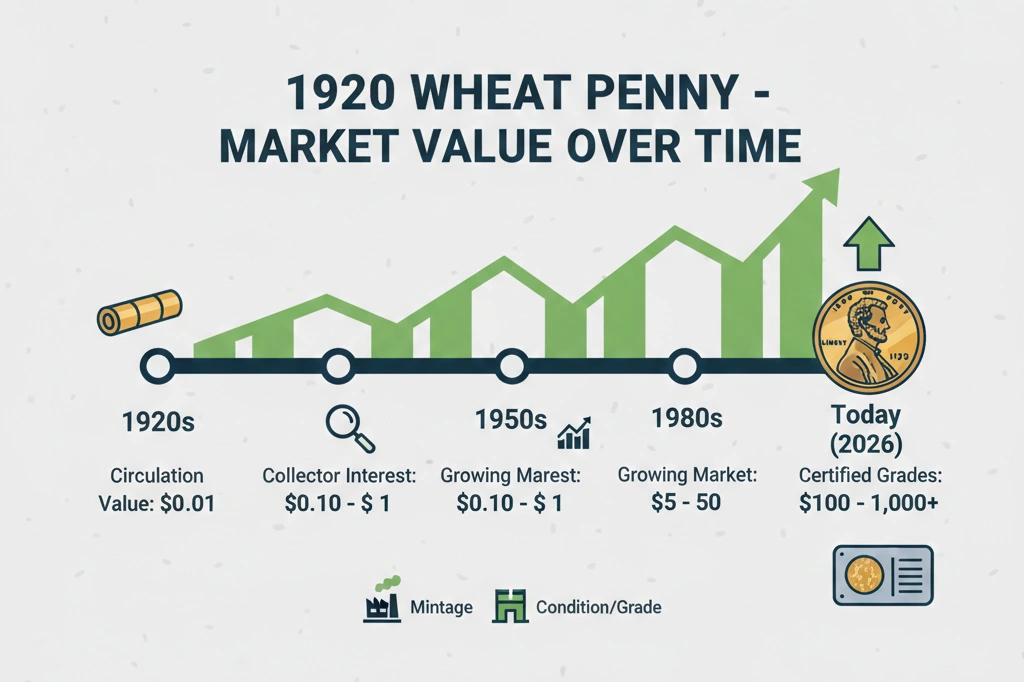
Value Change Dynamics and Market Cycles
Analyzing data over the last 20 years allows for identifying long-term trends.
Grades MS60–MS64: Value growth is practically absent, remaining within 1.5% annually.
Grades MS65–MS66: A stable price increase of 3.8% per year is observed due to the reduction of supply at auctions.
Grades MS67: High price volatility reaching 20% in both directions upon new data appearing in Population Reports.
In percentage terms, owning a 1920-S coin in MS65 RD grade brought a return of 140% over the period from 2010 to 2024/25.
Valuable Specimen Identification Recommendations
Determining the potential value of a 1920 coin requires following a consistent action algorithm with the coin value app.
The first action involves checking for the presence of original mint luster.
The absence of luster combined with dark oxidation spots automatically transitions the coin to the BN category.
The second action consists of studying the fine details of Lincoln's portrait.
Preserving clear hair lines above the ear indicates a condition of EF40 and higher.
The third action involves searching for the mint mark under the date.
Discovering the letters "D" or "S" while maintaining a high grade increases the market valuation 10–40 times compared to the Philadelphia issue.
The fourth action involves checking the edge for filings or mechanical damage reducing the value to zero.
Scarcity Based on Reports
The real rarity of a coin is confirmed by the number of certified units in databases.
For 1920, the PCGS statistics appear as follows.
1920 (P) MS67 RD: 23 pieces registered.
1920-D MS66 RD: 15 pieces registered.
1920-S MS65 RD: 14 pieces registered.
Comparing these figures with the multi-million mintages confirms the fact of 99.99% of coins in ideal condition disappearing.
This circumstance guarantees the preservation of high value for lots having a confirmed grade above MS65.
Economic indicators suggest the continuation of numismatic capital concentration in the segment of rare years and high grades.
The expected reduction in available 1920 bank rolls on the market will cause a deficit of coins in Gem Uncirculated condition.
The projected price growth for MS66 RD grades will be 5% annually.
Ordinary coins from circulation will remain mass material, possessing no prospects for significant appreciation.